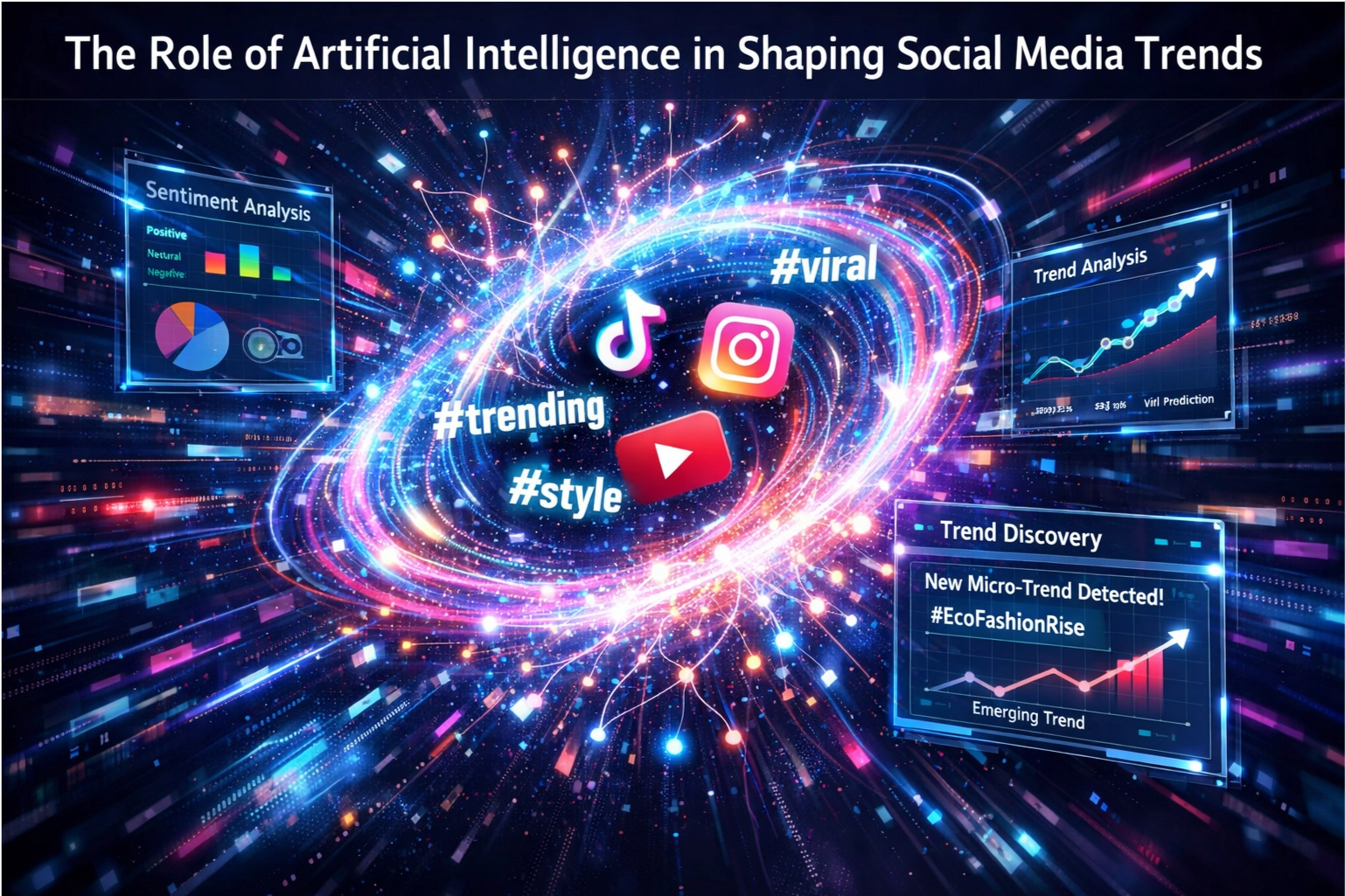
Social media has always been a reflection of human behavior—what we like, what we share, and how we communicate. Over the past few years, however, the way trends are created, spread, and amplified has changed dramatically. At the center of this transformation is Artificial Intelligence (AI).
In today’s digital world, social media trends are no longer driven solely by human creativity or chance virality. Instead, they are increasingly shaped by intelligent algorithms that analyze behavior, predict preferences, and influence what billions of users see every day. AI is quietly working behind the scenes, redefining how content goes viral, how communities form, and how brands and creators reach their audiences.
This article explores the role of artificial intelligence in shaping social media trends, why it matters, and what it means for businesses, creators, and everyday users.
How AI Became Central to Social Media
In the early days of social media, content visibility was simple. Posts appeared in chronological order, and trends spread organically through shares and word-of-mouth. As platforms grew, this model became unsustainable. With millions of posts published every minute, platforms needed smarter systems to decide what content deserved attention.
AI emerged as the solution.
By using machine learning and data analysis, social media platforms began prioritizing content based on relevance rather than time. Over time, these systems evolved into complex AI-driven algorithms capable of understanding user behavior at an incredibly detailed level. Today, AI doesn’t just organize content—it actively shapes trends.
AI and Content Discovery: Why You See What You See
One of the most significant ways AI influences social media trends is through content discovery.
Every time you scroll through your feed, AI analyzes:
-
Your past likes, comments, and shares
-
How long you watch a video
-
Which posts you skip
-
What topics you engage with most
Using this data, algorithms predict what content is most likely to keep you engaged. As a result, certain posts gain massive exposure while others remain unseen. This selective visibility is how trends are born.
When AI detects a piece of content gaining rapid engagement, it pushes it to more users with similar interests. This creates a snowball effect, turning ordinary posts into viral trends within hours.
Predicting Trends Before They Happen
AI doesn’t just react to trends—it predicts them.
By analyzing massive amounts of real-time data, AI systems can identify patterns that humans might miss. These patterns allow platforms and brands to spot emerging trends before they go mainstream.
For example, AI can detect:
-
Rising keywords and hashtags
-
Sudden shifts in audience sentiment
-
New content formats gaining traction
-
Changes in user behavior across regions
This predictive ability is invaluable for marketers and creators. Those who act early on emerging trends often gain a competitive advantage, reaching audiences before content becomes oversaturated.
The Impact of AI on Social Media Content Creation
AI is also changing how content is created.
Today, many creators and brands use AI-powered tools to:
-
Generate captions and headlines
-
Suggest hashtags and posting times
-
Edit videos and enhance visuals
-
Analyze which content formats perform best
These tools help creators work faster and smarter, but they also influence trends by standardizing what “works.” When AI tools recommend similar styles, formats, or tones, certain aesthetics naturally rise to the top.
This explains why trends like short-form videos, specific editing styles, or recurring content formats dominate platforms for months at a time.
Personalization and the Rise of Micro-Trends
One of AI’s most powerful effects on social media trends is personalization.
Instead of everyone seeing the same trends, AI creates individual trend ecosystems. What’s trending for one user may be completely different for another.
This has led to the rise of micro-trends—niche topics that thrive within specific communities. Fitness trends, interior design styles, financial advice formats, and even humor now exist in tightly defined audience bubbles.
AI enables platforms to:
-
Match trends to specific interests
-
Deliver hyper-relevant content
-
Keep users engaged longer
As a result, trends are no longer universal—they are personalized.
AI and Influencer Culture
Influencer marketing has been deeply influenced by AI-driven trend analysis.
Platforms use AI to determine:
-
Which creators gain visibility
-
Which posts are promoted
-
Which influencers align with audience interests
This means influencers are often discovered and elevated by algorithms, not just followers. AI also helps brands identify influencers whose audiences match their target market, making collaborations more strategic and data-driven.
In recent years, AI-generated and virtual influencers have also emerged. These digital personas are designed based on trend data, audience preferences, and engagement metrics—further demonstrating AI’s growing influence over social media culture.
Real-Time Trend Amplification
AI allows trends to spread faster than ever.
Through real-time monitoring, algorithms can instantly recognize spikes in engagement and push content to a wider audience. This speed transforms how trends evolve—what once took weeks now happens in hours.
Live streams, viral challenges, and trending sounds are all amplified by AI systems that prioritize momentum. Once a trend reaches a critical threshold, AI ensures it dominates feeds, search results, and recommendation sections.
This rapid amplification makes social media trends more intense—but also shorter-lived.
AI, Advertising, and Trend Monetization
Social media trends are no longer just cultural moments—they are commercial opportunities.
AI helps brands capitalize on trends by:
-
Matching ads with trending content
-
Adjusting campaigns in real time
-
Predicting which trends align with purchase intent
This allows businesses to turn trends into revenue faster and more efficiently. However, it also means trends can feel more commercialized, blurring the line between organic culture and paid promotion.
Ethical Concerns and Algorithmic Influence
As AI shapes social media trends, important ethical questions arise.
Some key concerns include:
-
Algorithmic bias
-
Echo chambers and filter bubbles
-
Mental health impacts
-
Transparency in content ranking
Because AI decides what content gets visibility, it holds immense power over public discourse and cultural influence. Platforms are increasingly under pressure to ensure fairness, diversity, and accountability in their algorithms.
Understanding AI’s role helps users become more conscious consumers of content rather than passive participants.
What This Means for Brands and Creators
For brands and creators, adapting to AI-driven trends is no longer optional.
Success in modern social media requires:
-
Understanding platform algorithms
-
Monitoring data and performance closely
-
Staying flexible and trend-aware
-
Balancing creativity with analytics
The most successful creators are those who use AI insights as guidance while maintaining authenticity and originality.
The Future of Social Media Trends
Looking ahead, AI will continue to shape social media trends in deeper and more subtle ways. Trends will become more personalized, predictive, and immersive. At the same time, human creativity will remain essential.
AI can identify patterns—but humans create meaning.
Conclusion
Artificial intelligence plays a central role in shaping social media trends today. From content discovery and personalization to influencer growth and trend prediction, AI influences nearly every aspect of how trends are formed and shared.
While this technology brings efficiency and opportunity, it also requires responsibility, transparency, and human oversight. As social media continues to evolve, understanding AI’s role empowers users, creators, and brands to engage more intentionally.
In the end, social media trends may be powered by algorithms—but they are still driven by people.
