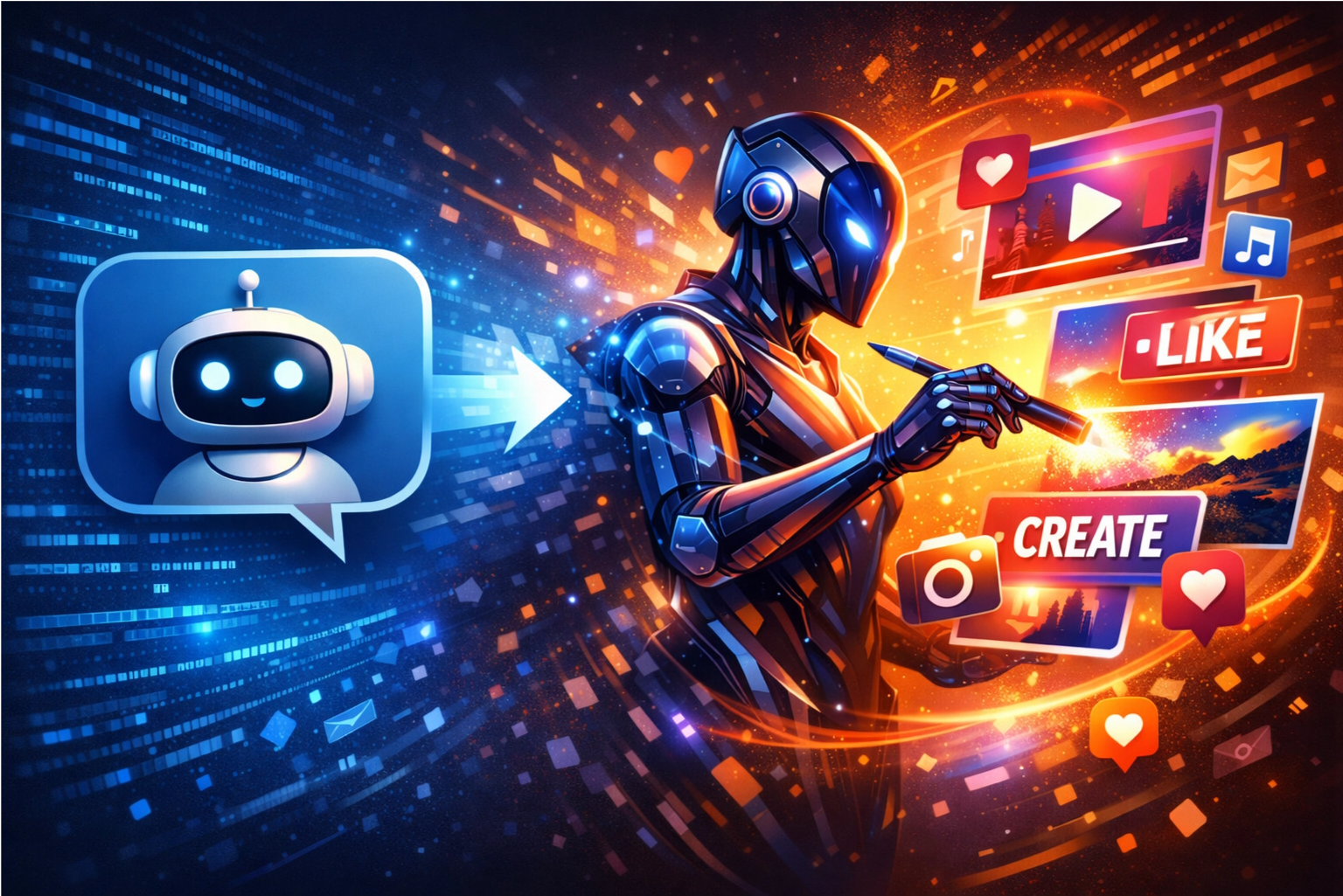
Not long ago, artificial intelligence on social media meant one thing: chatbots answering basic customer questions. Fast forward to today, and AI is doing much more than responding with prewritten scripts. It’s writing captions, editing videos, predicting trends, and even acting as a content creator in its own right.
AI’s growing role on social platforms is reshaping how people create, consume, and interact with content. From behind-the-scenes automation to front-facing creativity, AI has quietly become one of the most powerful forces in the social media ecosystem. And for users, creators, and brands alike, this shift is changing everything.
The Early Days: Chatbots and Customer Support
AI first gained traction on social platforms through chatbots. Brands needed faster ways to respond to messages, comments, and support requests, and AI provided a scalable solution.
Early chatbots were simple. They followed rules, recognized keywords, and offered basic responses like:
-
Order status updates
-
Frequently asked questions
-
Business hours and contact details
While limited, these bots solved a major problem: delayed responses. Faster communication improved customer satisfaction and reduced the workload for social media teams.
From an SEO and engagement perspective, responsiveness also helped brands maintain stronger relationships with their audiences.
The Shift Toward Smarter Conversations
As natural language processing improved, chatbots became more conversational. Instead of sounding robotic, AI began understanding context, intent, and tone.
Modern AI chatbots can:
-
Hold multi-step conversations
-
Understand slang and casual language
-
Route complex issues to human agents
-
Personalize responses based on user behavior
This evolution marked the first step in AI moving from a support role into something more dynamic—active participation in social interactions.
AI as a Content Assistant
Once AI mastered language understanding, the next logical step was content creation. Today, AI plays a major role in helping users and brands produce social media content more efficiently.
Writing Captions and Posts
AI tools now help generate:
-
Social media captions
-
Post ideas and hooks
-
Hashtags and keywords
-
Ad copy for campaigns
Instead of starting from a blank page, creators can use AI to draft content and refine it with their personal voice. This speeds up workflows without eliminating creativity.
From an SEO standpoint, AI-assisted writing also helps optimize content with relevant keywords and improved readability.
Visual Creativity: AI Enters the Design Space
Social media is a visual-first environment, and AI has adapted quickly.
AI-powered design tools can:
-
Generate images from text prompts
-
Suggest layouts and color schemes
-
Resize content for different platforms
-
Maintain brand consistency
These tools have lowered the barrier to entry for creators and small businesses, making professional-looking visuals accessible without design expertise.
As a result, social platforms are flooded with higher-quality visuals, raising the overall standard of content.
The Rise of AI Video Creation
Short-form video has become the most dominant content format across social platforms. AI has played a major role in making video creation faster and easier.
AI video tools now:
-
Automatically edit clips
-
Add captions and subtitles
-
Enhance audio and visuals
-
Repurpose long videos into short-form content
Since captioned videos perform better for accessibility and engagement, AI helps creators reach wider audiences without extra effort.
This shift has allowed more users to participate in video-driven platforms like TikTok, Instagram Reels, and YouTube Shorts.
AI as a Full-Fledged Content Creator
One of the most controversial developments is AI acting not just as an assistant—but as a creator.
AI-generated influencers, virtual avatars, and automated content accounts are becoming increasingly common. These AI-driven creators can:
-
Post consistently without burnout
-
Adapt content based on performance
-
Interact with audiences through comments and messages
While they lack human emotion, they excel at consistency, data-driven optimization, and scalability.
For platforms, AI creators mean more content. For audiences, it raises new questions about authenticity and trust.
Algorithm Intelligence: How AI Shapes What You See
Beyond content creation, AI plays a massive role in content distribution. Social media algorithms rely heavily on AI to decide what appears on your feed.
These systems analyze:
-
Engagement patterns
-
Viewing behavior
-
Interaction history
-
Content relevance
AI predicts what content will keep users engaged longer, then prioritizes it accordingly. This is why feeds feel personalized—and sometimes eerily accurate.
Understanding this helps creators and marketers design content that aligns with platform algorithms without sacrificing authenticity.
Trend Prediction and Virality
One of AI’s most powerful roles on social platforms is trend prediction.
AI systems analyze millions of data points to identify:
-
Emerging hashtags
-
Viral audio and formats
-
Shifts in audience interest
By spotting trends early, AI gives creators and brands a chance to ride the wave before it peaks.
From a marketing and SEO perspective, early trend adoption often leads to higher reach, stronger engagement, and increased visibility.
The Human-AI Collaboration Model
Despite AI’s growing presence, the most successful content still comes from human-AI collaboration.
Humans bring:
-
Emotion
-
Storytelling
-
Cultural awareness
-
Ethical judgment
AI brings:
-
Speed
-
Data analysis
-
Scalability
-
Consistency
When combined, this partnership produces content that is both efficient and meaningful. AI handles repetitive tasks, while humans focus on creativity and connection.
Ethical Concerns and Authenticity Challenges
As AI becomes more visible on social platforms, ethical questions are impossible to ignore.
Key concerns include:
-
Transparency about AI-generated content
-
Data privacy and user tracking
-
The impact on human creators
-
The risk of misinformation
Audiences value authenticity, and platforms are beginning to explore labeling AI-generated content to maintain trust.
Responsible use of AI will be critical as its influence continues to grow.
What This Means for Brands and Creators
For brands and creators, AI is no longer optional. It’s a competitive advantage.
Those who embrace AI can:
-
Create content faster
-
Understand audiences better
-
Optimize performance more effectively
Those who ignore it risk falling behind in an increasingly algorithm-driven environment.
However, success still depends on maintaining a human voice and genuine connection with audiences.
The Future of AI on Social Platforms
AI’s role on social platforms will continue to expand. Future developments may include:
-
Hyper-personalized content feeds
-
Real-time content generation
-
Advanced virtual influencers
-
Deeper emotional analysis
As technology evolves, the line between human and AI-created content will blur even further.
