Artificial intelligence has quietly become one of the most powerful forces shaping social media. From personalized feeds and targeted advertising to content moderation and trend prediction, AI influences nearly every interaction we have online. It decides what we see, what we don’t see, and sometimes even how we feel while scrolling.
While AI brings undeniable benefits to social media platforms, brands, and users, it also raises important ethical questions. How much data is too much? Who controls the algorithms? And where should we draw the line between personalization and manipulation?
In this article, we explore the ethics of AI on social media, examining both the opportunities it creates and the risks it poses in today’s digital world.
The Growing Role of AI in Social Media
Social media platforms rely on AI to manage massive amounts of content and user data. With billions of posts shared every day, manual oversight is impossible. AI helps platforms:
-
Personalize content feeds
-
Detect harmful or inappropriate content
-
Target ads more effectively
-
Analyze user behavior and engagement
Without AI, modern social media as we know it simply wouldn’t function. However, the speed and scale at which AI operates make ethical responsibility more important than ever.
The Opportunities AI Brings to Social Media
When used responsibly, AI can create more positive, engaging, and inclusive online experiences.
Personalized User Experiences
One of AI’s biggest strengths is personalization. By analyzing user behavior, AI delivers content that aligns with individual interests, preferences, and habits.
This personalization:
-
Reduces information overload
-
Helps users discover relevant creators and communities
-
Makes social media more engaging and enjoyable
For many users, AI-driven personalization improves overall satisfaction and platform usability.
Improved Content Moderation
AI plays a crucial role in identifying harmful content such as hate speech, misinformation, spam, and harassment. Automated systems can flag or remove content faster than human moderators alone.
This helps:
-
Create safer online spaces
-
Protect vulnerable users
-
Reduce the spread of harmful material
While not perfect, AI-assisted moderation is a key tool in maintaining platform integrity.
Greater Accessibility and Inclusion
AI can make social media more accessible through features like:
-
Automatic captions for videos
-
Language translation
-
Voice-to-text and text-to-speech tools
These innovations help users with disabilities and break down language barriers, promoting more inclusive digital communities.
Opportunities for Brands and Creators
AI empowers creators and businesses by providing insights into audience behavior, content performance, and emerging trends. This allows:
-
Smaller creators to compete more fairly
-
Brands to deliver more relevant messaging
-
Content to reach audiences who genuinely care
When used ethically, AI supports creativity rather than suppressing it.
The Ethical Risks of AI on Social Media
Despite its benefits, AI also introduces serious ethical challenges that cannot be ignored.
Data Privacy and User Consent
AI systems depend on vast amounts of personal data, including browsing habits, location, interactions, and preferences. Many users are unaware of how much data is collected or how it’s used.
Ethical concerns include:
-
Lack of transparency
-
Insufficient user consent
-
Potential misuse of personal data
Without strong data protection practices, user trust can quickly erode.
Algorithmic Bias and Discrimination
AI learns from existing data—and that data can reflect human bias. As a result, algorithms may unintentionally favor certain groups while disadvantaging others.
Examples include:
-
Unequal visibility for creators
-
Biased content moderation decisions
-
Reinforcement of stereotypes
Addressing algorithmic bias requires diverse data sets, regular audits, and human oversight.
Filter Bubbles and Echo Chambers
Personalization can become problematic when it limits exposure to diverse perspectives. AI often prioritizes content that aligns with a user’s existing beliefs, creating echo chambers.
This can:
-
Reduce critical thinking
-
Increase polarization
-
Spread misinformation more easily
Ethical AI design should balance personalization with content diversity.
Manipulation and Behavioral Control
AI is highly effective at capturing attention. In some cases, this leads to manipulative design practices that prioritize engagement over user well-being.
Risks include:
-
Addiction-like scrolling behavior
-
Emotional manipulation through content delivery
-
Amplification of outrage-driven content
When engagement becomes the primary goal, ethical boundaries can blur.
AI, Advertising, and Ethical Targeting
AI-driven advertising raises additional ethical questions.
Hyper-Targeted Advertising
AI allows advertisers to target users with incredible precision. While this improves ad relevance, it can also feel invasive.
Concerns include:
-
Exploiting vulnerable audiences
-
Influencing behavior without awareness
-
Blurred lines between persuasion and manipulation
Ethical advertising requires transparency and respect for user autonomy.
Political and Social Influence
AI-powered targeting has been used in political campaigns and social movements. While this can encourage civic engagement, it also opens the door to misinformation and manipulation.
Platforms must carefully regulate how AI is used in politically sensitive contexts.
Transparency and Accountability in AI Systems
One of the biggest ethical challenges is the lack of transparency.
Black Box Algorithms
Many AI systems operate as “black boxes,” meaning users don’t fully understand why certain content is shown or suppressed.
Ethical AI should include:
-
Clear explanations of algorithmic decisions
-
User controls over personalization
-
Accountability for unintended consequences
Transparency builds trust and empowers users.
The Human Role in Ethical AI
AI should not operate without human oversight.
Human Moderation and Judgment
While AI can flag issues, humans are needed to:
-
Make nuanced decisions
-
Handle cultural and emotional context
-
Address edge cases responsibly
Ethical social media systems rely on collaboration between humans and machines.
Responsible Design and Regulation
Governments, platforms, and tech companies all share responsibility for ethical AI development. This includes:
-
Clear policies and guidelines
-
Compliance with data protection laws
-
Ongoing ethical evaluations
Regulation should protect users without stifling innovation.
The Future of Ethical AI on Social Media
As AI continues to evolve, ethical considerations will become even more important. Future developments may include:
-
User-controlled personalization settings
-
AI systems designed with well-being in mind
-
Greater transparency in algorithm design
-
Stronger global data protection standards
The goal is not to eliminate AI, but to guide its use responsibly.
Why Ethics Matter More Than Ever
Social media shapes opinions, relationships, and culture. When AI influences these spaces, ethical responsibility becomes essential.
Technology should serve people—not the other way around.
By prioritizing ethics, platforms can create healthier digital environments that foster connection, creativity, and trust.
Final Thoughts
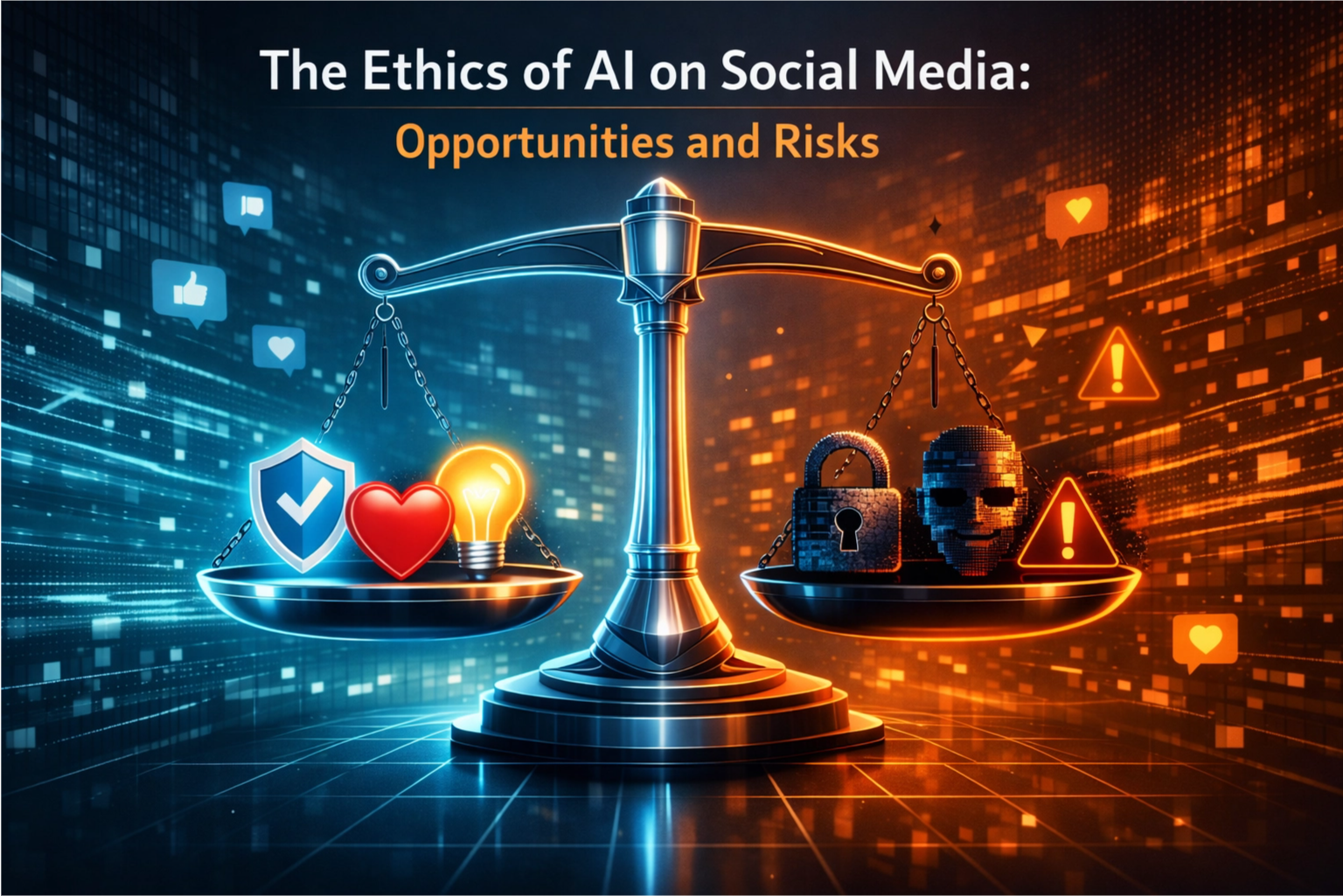
The ethics of AI on social media sit at the intersection of opportunity and risk. AI has the power to personalize experiences, improve safety, and support creativity—but it also carries risks related to privacy, bias, manipulation, and transparency.
The future of social media depends on how responsibly AI is designed and used. Ethical AI is not just a technical challenge—it’s a human one. When platforms balance innovation with accountability, AI can become a force for good rather than a source of harm.
In the end, the question isn’t whether AI belongs on social media. It’s how we choose to shape it.
