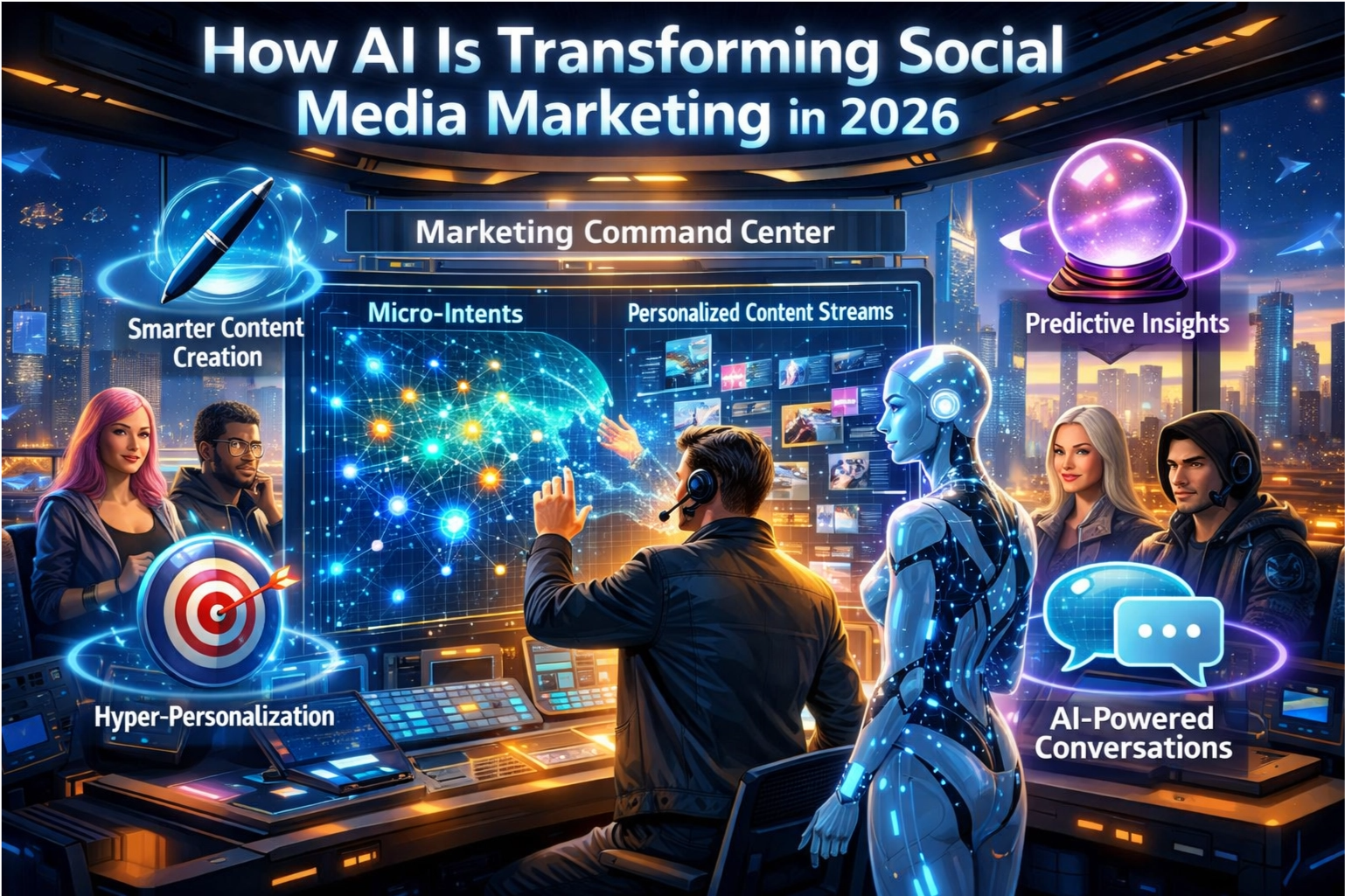
Social media marketing has always been about understanding people—what they like, how they behave, and what motivates them to engage. In 2026, that understanding is being reshaped at an unprecedented pace by artificial intelligence (AI). What once required large teams, manual analysis, and constant trial and error is now being powered by smart algorithms capable of learning, predicting, and optimizing in real time.
AI is no longer just a “nice-to-have” tool in social media marketing. It has become a core driver of strategy, creativity, performance, and growth. From content creation to audience targeting and analytics, AI is transforming how brands connect with their audiences—and how consumers experience social platforms.
In this article, we’ll explore how AI is reshaping social media marketing in 2026, what it means for businesses and creators, and how marketers can adapt to stay ahead.
The Evolution of AI in Social Media Marketing
AI’s role in social media didn’t appear overnight. Early applications focused on simple automation—scheduling posts, basic analytics, and spam filtering. Over time, machine learning models became more sophisticated, allowing platforms to analyze massive amounts of user data in real time.
By 2026, AI has evolved from a backend tool into a front-facing force that directly influences content discovery, engagement, and purchasing decisions. Algorithms now understand not only what users click, but why they engage, how long they stay, and what emotions content triggers.
This shift has fundamentally changed how social media marketing works.
Smarter Content Creation at Scale
One of the most visible transformations AI has brought to social media marketing is content creation.
In 2026, AI tools can:
- Generate captions, headlines, and hashtags optimized for engagement
- Adapt tone and language to different platforms and audiences
- Suggest content ideas based on trending topics and past performance
- Create short-form video scripts, hooks, and storytelling structures
Marketers no longer start with a blank page. Instead, AI acts as a creative partner, offering drafts and ideas that humans refine with personality, emotion, and brand voice.
Importantly, the most successful brands are not replacing creativity with AI—they’re enhancing it. Human insight combined with AI efficiency results in faster production cycles and more consistent quality across platforms.
Hyper-Personalization: Speaking to Individuals, Not Audiences
In 2026, generic content no longer performs well. Audiences expect experiences that feel personal—and AI makes this possible at scale.
AI-powered social media marketing enables:
- Personalized content feeds based on user behavior and preferences
- Dynamic ads that change visuals or messaging for different users
- Tailored recommendations based on browsing and interaction history
Instead of targeting broad demographics like age or location, marketers now target micro-intents—specific behaviors, emotions, and moments of interest.
For example, two users may see the same product promoted in entirely different ways depending on their past interactions. This level of personalization dramatically increases engagement, trust, and conversion rates.
AI-Driven Social Media Advertising
Paid social media has become more intelligent—and more competitive—than ever.
In 2026, AI plays a central role in:
- Audience segmentation and lookalike modeling
- Budget optimization across campaigns and platforms
- Predicting ad fatigue and creative burnout
- Automatically testing and refining ad variations
Instead of manually adjusting campaigns, marketers rely on AI systems that continuously learn from performance data and make real-time optimizations.
This doesn’t eliminate the need for strategy. Instead, it allows marketers to focus on big-picture decisions—brand positioning, storytelling, and long-term growth—while AI handles execution-level efficiency.
Advanced Analytics and Predictive Insights
One of AI’s most powerful contributions to social media marketing is its ability to turn raw data into actionable insights.
In 2026, AI analytics tools go beyond reporting past performance. They help marketers:
- Predict which content will perform best before posting
- Identify the best time, format, and platform for publishing
- Detect early signs of audience churn or declining engagement
- Measure emotional responses through sentiment analysis
This shift from reactive to predictive marketing allows brands to stay ahead of trends instead of chasing them.
Data no longer feels overwhelming—it becomes a clear guide for smarter decisions.
The Rise of AI-Powered Influencers and Virtual Creators
Another major trend shaping social media in 2026 is the rise of AI-generated influencers and virtual creators.
These digital personalities:
- Operate 24/7 without burnout
- Maintain consistent branding and messaging
- Can be customized for different markets and languages
- Are fully controlled by brands or agencies
While human influencers remain essential for authenticity and emotional connection, AI influencers are gaining traction for campaigns focused on scalability, experimentation, and cost efficiency.
This trend raises important ethical questions—but it also highlights how deeply AI is embedded in modern social media ecosystems.
Customer Engagement and AI-Powered Conversations
Engagement is no longer limited to likes and comments. In 2026, AI-powered chatbots and conversational tools play a key role in social media marketing.
AI enables:
- Instant replies to customer inquiries via DMs and comments
- Personalized product recommendations through chat
- Automated lead qualification and follow-ups
- Seamless transitions from conversation to purchase
When done well, these interactions feel natural and helpful—not robotic. The goal is not to replace human support, but to ensure speed, consistency, and availability, especially as audiences expect real-time responses.
Ethical Considerations and Transparency
With great power comes great responsibility. As AI becomes more influential in social media marketing, ethical considerations are more important than ever.
Key concerns in 2026 include:
- Data privacy and consent
- Transparency around AI-generated content
- Avoiding manipulation or misleading personalization
- Ensuring diversity and fairness in algorithms
Brands that succeed long-term are those that use AI responsibly, clearly communicate how data is used, and maintain trust with their audiences.
Human oversight remains essential. AI should support decision-making—not replace accountability.
How Marketers Can Stay Competitive in 2026
To thrive in the AI-driven social media landscape, marketers need to evolve their skills and mindset.
Key strategies include:
- Learning how to work with AI tools, not against them
- Focusing on creativity, storytelling, and emotional intelligence
- Using data insights to inform—not dictate—strategy
- Staying updated on platform changes and AI regulations
The most successful marketers in 2026 are not the most technical—they are the most adaptable.
Conclusion
AI is no longer shaping the future of social media marketing—it is the present. In 2026, brands that embrace AI thoughtfully are able to create more relevant content, build deeper relationships, and achieve better results with greater efficiency.
However, the heart of social media remains unchanged: people want to feel understood, inspired, and connected. AI provides the tools, but humans provide the meaning.
When technology and creativity work together, social media marketing becomes not just smarter—but more human.
